SMALL BUSINESS RESTRUCTURING
Small business restructuring (SBR): keep trading while you deal with debt
Authored by Patrick Loi, Managing Principal and Registered Liquidator, Greengate Advisory · Updated 19 September 2026

Authored by Patrick Loi, Managing Principal and Registered Liquidator, Greengate Advisory · Updated 19 September 2026
Short answer: Small business restructuring (SBR) lets an eligible company with debts of $1 million or less keep trading, with the directors still in control, while a registered small business restructuring practitioner helps it put a repayment plan to creditors. If creditors accept, the company pays what the plan says and the rest of the covered debt is released.
If your company is struggling with ATO debt, supplier debt or a director penalty notice, SBR can be a cheaper and faster alternative to administration or liquidation. Our registered liquidators act as small business restructuring practitioners and explain every step in English, Mandarin, Cantonese or Korean.

If you are not sure, we can check eligibility in a confidential first conversation.
The ATO is a creditor in most small business restructurings. It generally supports plans that give creditors a better return, within a reasonable time, than liquidation would. It may reject plans where the company has a poor tax compliance history, director loans are unpaid, or the plan would give the business an unfair advantage. After a plan is accepted, the company must keep its tax lodgements and payments up to date. See also our guide to ATO debt help for company directors.
In most small business restructurings the ATO is a creditor, so its vote is often decisive. Before it votes, it asks the restructuring practitioner for supporting information. The directors and the company’s accountant usually prepare most of it:
The ATO may ask for more on a case-by-case basis, and it won’t consider a plan until it has all the supporting information. Also, before the plan goes to creditors, the company must bring its tax lodgements up to date and pay employee entitlements that are due, including superannuation.
The practitioner must send the ATO the draft plan and all the supporting information at least 5 full business days before the plan goes to creditors. Because the practitioner has 20 business days from the appointment to prepare the plan (extendable once by up to 10 business days), start gathering the information early, ideally in the first two weeks. However, if the ATO rejects a plan, there is no review of that decision.
Directors and their relatives are “excluded employees”. For them, only the first $2,000 of unpaid entitlements, such as superannuation, counts as a protected (priority) amount, and the company must pay it before the plan goes to creditors. Anything above $2,000 becomes an ordinary unsecured claim in the restructuring plan.
This is a simplified illustration. In practice, the treatment depends on the company’s circumstances. Also, unpaid super can create a super guarantee charge owed to the ATO.
We work with you and your accountant to understand what the ATO will look for, assist with gathering and answering any questions around the supporting information and cash flow forecast, and get the draft plan to the ATO in time for its feedback. We explain each requirement in plain English, Mandarin or Korean.
Sources: ATO – Small business restructuring and ASIC – Small business restructuring and the restructuring plan.
If you have received a non-lockdown director penalty notice, appointing a small business restructuring practitioner within the 21 days remits that penalty. Director penalties that are not remitted remain separate from the company’s debt: the ATO says it can still pursue them, although plan payments may reduce the amount. Read our DPN guide.
A registered liquidator (or a liquidator registered only for SBR work) who is appointed to help the company through SBR. They help prepare the plan, certify the company’s position to creditors, run the vote and administer the plan.
About 35 business days from appointment to the creditor vote (20 to prepare the plan, 15 for creditors to vote), plus extensions if granted. The plan then runs for the period it sets out.
The appointment is a public insolvency notice, so lenders and suppliers can find it. It is a company process: it does not by itself make you personally bankrupt, but any personal guarantees and director penalties still need attention.
Your first consultation is free and confidential. We will explain the costs of an SBR for your company before you decide to go ahead.
Yes, ATO debt is usually the largest debt in the plan. The ATO votes like other creditors and assesses each plan on its merits.
Directors are excluded employees, so only the first $2,000 of their unpaid super counts as protected, and the company must pay it before the plan goes to creditors. Anything above that becomes an unsecured claim under the plan. For example, if the company owes a director $40,000, it pays $2,000 first and the plan deals with the other $38,000.
Authored by Patrick Loi, Managing Principal and Registered Liquidator. Patrick has over 20 years of business restructuring and insolvency experience and founded Greengate Advisory. Meet our team.
Check if your company is eligible for SBR
Confidential · English, 中文, 한국어
This page is general information, not advice about your situation.

An NDIS provider with more than $2 million owed to the ATO was restructured through voluntary administration and a deed of company arrangement funded from trading profits.


Receivers and managers appointed by a secured lender stabilised a 16-level Melbourne CBD office building, ran a competitive EOI campaign and sold it to a developer.

Capability: Insolvency, Restructuring & TurnaroundIndustry: TourismAppointment: Voluntary Administration followed by Liquidation Overview Subsidiaries of an ASX listed Company that operated high-e


If your company owes the ATO, you can pay in full, ask for a payment plan, restructure, or wind up. Acting before the ATO issues a director penalty notice keeps...
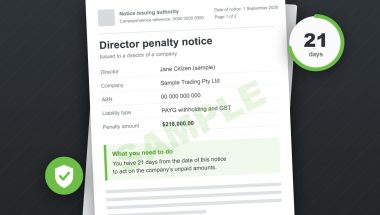
A director penalty notice (DPN) means the ATO can make you personally liable for some of your company’s tax debts. You have 21 days from the date the notice was...

Updated September 2026. Director IDs are now well established. Here is where things stand today: Source: ASIC, Director identification numbers (director IDs). The rest of this article was first publis
Contact us for a free confidential consultation with one of our experts.
You can discuss your position and all possible options
in your language – Chinese, Korean, English and other Asian languages.
Get in touch today with experts that understand your needs.
Let us help you navigate through times of uncertainty.